
ELEVATE ON DEMAND • AUDIO RELIEF • HARSH SELF-TALK
You can want better from yourself without making yourself the problem.
“Why are you like this?”
“You should be further by now.”
“Get it together.”
“Other people handle this better.”
Sometimes the hardest part of a difficult moment isn’t what happened.
It’s what your own mind starts saying about you afterward.
You may genuinely want to learn from the mistake.
Do better next time.
Hold yourself accountable.
Keep growing.
You just don’t need to tear yourself down to do any of those things.
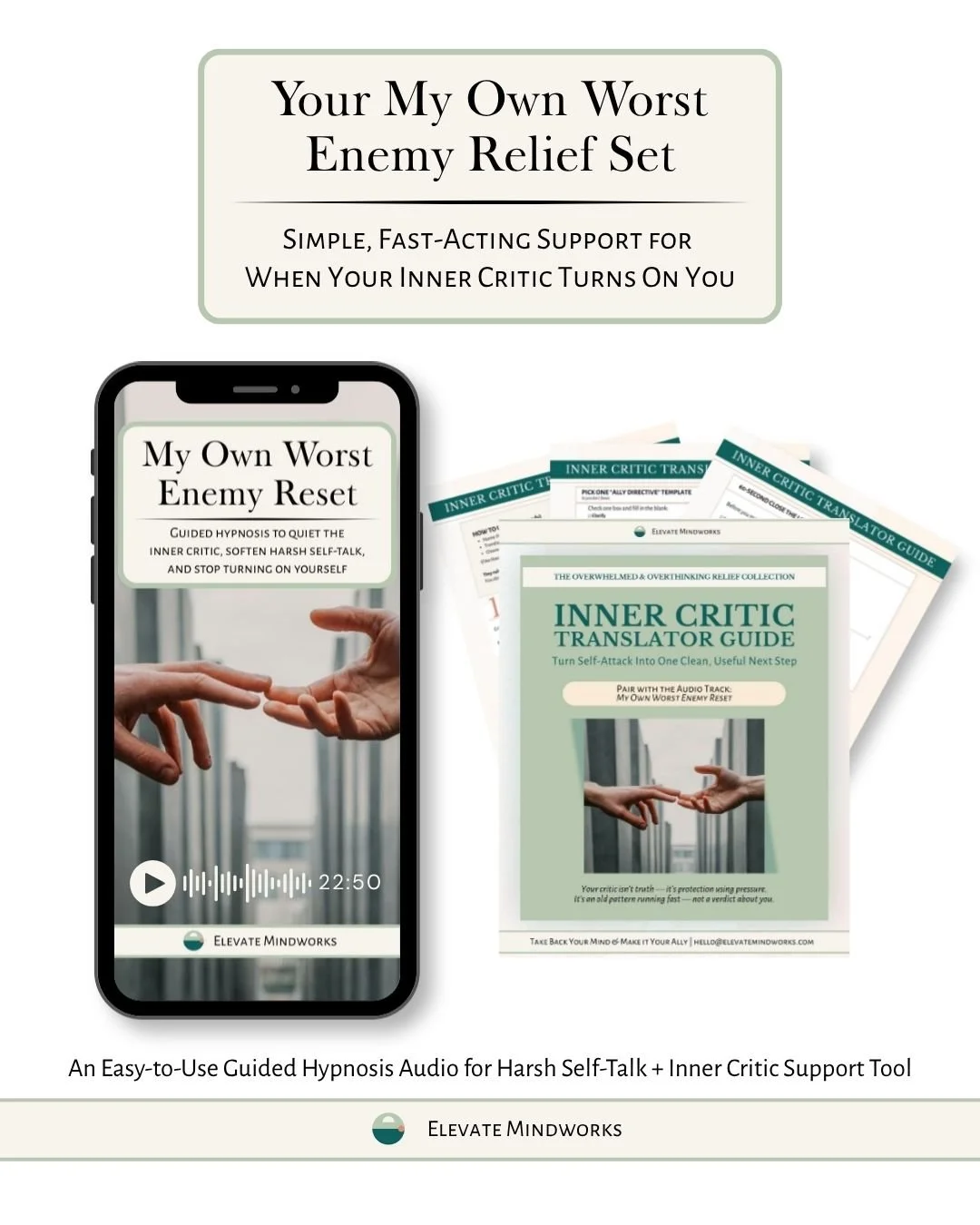
The My Own Worst Enemy Reset helps you soften the internal attack, understand what may be underneath it, and practice a more useful way of responding to yourself.
22:50 Guided Hypnosis + Inner Critic Translator Guide • Immediate access • Use again whenever you need it
WHAT ONCE MADE SENSE CAN BE UPDATED FOR WHAT YOU NEED NOW.
Your mind may have learned to use criticism for a reason.
Catch the mistake before someone else does.
Push harder so you don’t fall behind.
Prepare for judgment.
Keep your standards high.
Get ahead of rejection.
Those responses may have helped you navigate something important at another point in your life.
You don’t have to decide they were wrong in order to recognize that they may not be the most useful way forward now.
Understanding how you got here gives you somewhere more useful to begin.
You can keep what still matters — your standards, your accountability, your desire to grow — while changing the way your mind tries to help you meet them.
Accountability isn’t self-attack.
It’s seeing your part clearly, making the adjustment, and having more choice in what happens next.
HEAR THE RESET BEFORE YOU BUY IT.
A short excerpt from the actual My Own Worst Enemy Reset so you can hear Jasmin’s voice, pacing, and what it feels like to approach critical thoughts with curiosity instead of automatically believing them or fighting against them.
INSPIRED BY REAL CLIENT WORK
The My Own Worst Enemy Reset was inspired by Jasmin’s hypnosis work with clients who are used to treating difficult feelings, mistakes, or reactions as something to criticize themselves for — rather than something they can understand and work with.
“I find myself asking more questions of why feelings come up rather than getting upset with myself BECAUSE feelings came up.”
— Private Elevate client
In the same reflection, this client described feeling more grounded in themselves and approaching their growth with more understanding rather than treating themselves as a problem that needed fixing.
WHAT YOU GET
22:50 GUIDED HYPNOSIS RESET
A private, self-guided experience for moments when your own inner voice starts making something difficult even harder.
Use it when:
One mistake becomes “Why do I always do this?”
Comparison turns into a verdict about where you should be by now.
Your standards become another reason to stay disappointed in yourself.
You’re about to do something visible and your mind starts telling you why you shouldn’t.
You know something needs to change, but criticism becomes the way you try to force yourself into changing it.
You catch yourself speaking internally in a way you’d never speak to someone you respect.
The goal isn’t to make every thought perfect.
It’s to give yourself more room to understand what’s happening and decide what’s actually useful.
INNER CRITIC TRANSLATOR GUIDE
A practical tool for slowing the criticism down long enough to understand what’s underneath it.
Use it to ask:
What did the critical thought say?
What might this response be trying to accomplish?
Is there anything useful here for me to notice?
What do I actually need next?
You don’t have to make every critical thought true.
And you don’t have to fight with it just because it showed up.
You can learn from what comes up without using it against yourself.
WHAT IF YOU COULD TRUST YOURSELF TO LEARN, ADJUST, AND KEEP GOING?
Own a mistake and decide what you want to do differently next time.
Receive feedback and sort what’s useful from what isn’t.
Try something new without expecting yourself to already know how to do it perfectly.
Notice comparison and return to what your own life actually needs from you.
Correct course without turning the correction into evidence that something is wrong with you.
Recognize what went well while still seeing where you want to grow.
The goal isn’t to stop caring about your performance.
Or stop having standards.
Or convince yourself that everything you do is fine.
It’s developing a steadier way to meet yourself when something isn’t the way you want it to be.
What happens can become feedback for your growth instead of evidence against yourself.
Self-trust is knowing you can learn, adjust, and shape what comes next.
22:50 Guided Hypnosis + Inner Critic Translator Guide • Immediate + repeat access
-
No.
The goal isn’t to lower your standards, excuse behavior, or stop noticing when something needs to change.
It’s to separate useful accountability from the self-attack that can get attached to it.
You can still care deeply about doing well and growing.
You just get more choice in how you respond when something doesn’t go the way you wanted.
-
Sometimes there may be useful information inside a critical thought.
Maybe something needs attention.
Maybe you want to make a different decision.
Maybe there’s something you genuinely want to improve.
The Inner Critic Translator helps you slow the response down enough to determine what’s useful, what isn’t, and what you want to do next.
-
No.
The goal isn’t to eliminate every critical thought.
It’s to develop a different way of meeting those thoughts so you can understand what’s happening, take what’s useful, and respond with more choice.